Showing posts with label Homebrew. Show all posts

Saturday, January 26, 2013

Berliner Weisse Small Batch

Later in this post I'll include some links to some very well written technical information on how to perform a sour mash and specifically how to approach a sour mash to produce the berliner weisse style of beer.  My focus will simply be on my steps to produce a small batch, 1.6 gallons, of berliner weisse style beer.

Full allotment of hops!
I decided to brew a 1.6 gallon batch, enough to fill two 1 gallon fermenters with .8 gallons of wort.  Additionally rather than use the traditional approximate 50/50 pilsner malt/wheat malt ratio grain bill I went with a 70/30 US 2-row/rye malt grist.  For 1.6 gallons I used 33 oz of grain total along with 1/10th (2.8 grams) of an ounce of 7 AAU Cluster hops at 40 minutes in a 40 minute boil.  Due to the challenges of maintaining temperatures for such a small mash in my 5 gallon cooler style mash tun I mashed on the stove top with a mash liquor ratio of approximately 1.15 quarts water per pound of grain.  The target mash temp. was 147 degrees f. as you want this beer to finish very dry from around 1.030 down to approximately 1.006 or lower!


Bucket o'mash in the cooler with 122 degree water.
Here's where the fun begins, the sour mash.  After my saccrification rest I cut the lid off a 1 gallon jug of water saved from a previous brew session, sanitized thoroughly with star san, and dumped the mash into the jug.  The jug containing the mash is placed in a cold water bath in the sink to bring the temperature down to around 122 degrees.  I then added 4 oz. of unmilled 2-row, stirring it in thoroughly to disperse equally among the mash.  Of note here is that most literature says something to the effect of 'throw in a hand full of grain' or a couple ounces for a 5 gallon batch.  I purposefully over inoculated believing in the theory of adding as many Lactobaccillus delbruckii bacterium as possible theorizing they would 'out compete' less desirable bacteria.  Adding the unmilled-unmashed grain is how we inoculate our mash with Lactobacillus delbruckii to produce the desired sour effect.  I then placed this jug inside a cooler with 122 degree water inside, closed the lid and placed something heavy on top of the cooler lid to maintain a tight seal and minimal heat loss.  From there it was a matter of waiting and changing the cooler water bath every 4-8 hours to maintain temps as close to 120 as possible.

Plastic wrap with few bubbles helps to keep oxygen out.
A note here, it's fairly important to keep the sour mash at 115-120 degrees f. and keep the mash covered with plastic wrap to inhibit the growth of less desirable bacteria present in most any sour mash.  Here are the links I promised earlier covering the technical aspects of a sour mash berliner weisse.

I waited 49 hours allowing the sour mash to do it's sour thing, then treated the mash and wort as you would any normal beer.  It was at about 40 hours into the sour mash that I first tasted the mash.  It was nutty and lightly bready up front, tart, acidic, reminded me of lemonade.  Before briefly covering the remaining process I'd like to share that my sour mash was exceptionally clean simply smelling a little sour and little else.  A brief search will provide dozens of accounts of exceedingly smelly sour mashes.  I attribute my relatively clean mash to my inoculation rate, keeping the mash covered with plastic wrap, and attention paid to keeping the mash temps between 115 and 120.  I dumped the mash into my standard mash tun along with a quantity of boiling water to bring the temperature up into the high 160s.  From there I batch sparged, an oddity for me, producing a very low efficiency which I expected with such a shallow grain bill.  

Dense foam at the start of the boil is typical for this style.
As noted above I performed a 40 minute boil.  Some berliner weisse are not boiled at all while others undergo anywhere from a 5 - 60 minute boils.  The boiler was placed in an ice-water bath for chilling to around 70 degrees.  1/3rd package of Nottingham dry yeast was pitched into each one gallon fermenter.  This was a rather large over pitching rate, performed on purpose.  The thought with the pitching rate was to produce as clean a fermentation as possible even though fruitiness is tolerable within the style.  The fermenters were placed in a water bath-less swamp cooler with a constant air temperature of 58 degrees.  I'm trying to get a fermentation temperature of 60-61 degrees, quite cold for an ale yeast but Nottingham yeast can handle it!

Here is the recipe:
Size: 1.6 gallons
Grain:
1 lb 8 oz US 2-row pale malt - 73% of grain bill
9 oz rye malt - 27T of grain bill
Hops:
2.8 grams or .1 oz of Cluster at 7.0 AAU - target IBUs 7
Yeast:
Danstar Nottingham dry ale yeast
Extra:
1/2 whirlfloc tablet @15 minutes left in the boil

O.G. 1.029
F.G. 1.007 (estimated)
SRM 3
BU:GU .21
ABV 2.9%
Calories 111 per 12 oz

If you'd like to read further about the profile of this bubbly low alcohol beer proclaimed by some to be the most refreshing beer in the world I suggest reading the bjcp style guideline here: BJCP Berliner Weisse Guideline.

Tuesday, March 16, 2010

Competition Time

Earlier today I shipped my entries to the Peach State Brew Off. I had 3 entries:
Category 15A Weizen - Entered my recently brewed Explication hefe brewed with T-58
Prospects: I expect it'll be judged as too fruity for style, too high a fermentation temp.
Category 22C Wood-Aged - Entered 15 month old Northern English Brown wood-aged with hand selected & cured Hickory wood spiced with Bourbon.
Prospects: I feel best about this beer's flavor profile, but it's terribly over-carbed, otherwise it has a shot.
Category 23 Specialty Beer - Entered a 4 month old First Wort Hopped multi-styled ale. Ordinary Bitter strength (3.2% abv), Am. Pale Ale grain bill, and IPA bitterness (70+ smooth IBUs).
Prospects: Have no idea how this one will fair. It's a solid flavorful offering, depends on how the judges approach it.

I have no idea of exactly how large the competition is. However my entries were issued a number 1096-1098. I'm doubting this is a competition with over 1000 entries thus I'm guessing I'm entering biers 96-98. If this is true I'm guessing the competition will have less than 200 entrants, possibly substantially fewer. The cost is $7 per entry thus my cost are as follows:
$7 x 3 = $21 + $9.60 Shipping = $30.60 Competition cost
Plus cost of each bier at $.60 x 6 = $3.60 + $30.60 = $34.20 Total cost

Being honest I'm hoping to do well, but considering this is my first competition I have NO idea of what to expect. No matter the results it's pretty exciting!

Monday, March 15, 2010

Motherland Imperial Stout early tasting


This was taken on my birthday as just a first sample of the Motherland Imperial Stout from below. The apple flavor I mentioned isn't an acetaldehyde flavor but rather a young beer flavor, I suspect from the priming sugar. Overall this bier should age well and round into a beautiful elixir of the soul! Overall it's very well bittered yet malty the way a good RIS should be. It's a split between an Am. vs Eng. version of this bier probably leaning more toward English.

My next RIS attempt will have 2-4% more roasted malt to bump up that character substantially and a clean American ale yeast with prominent C-hop character. Just go in a different direction for the experience of it!

Saturday, March 13, 2010

Explication Wheat Ale

My home state of Mississippi has just one micro brewery in the whole state. They are a brave lot and do well with what they have to work with, meaning a very bier illiterate state. Perhaps bier culture or lack there of is a subject for another blog entry, but for now on to the subject of this entry. Lazy Magnolia is the name of the brewery and my favorite bier they produced was a Krystalweizen named Blue Heron. I used the past tense because it is a now discontinued product, lost in the streamlining of their offering a few years back. Again reference the lack of bier culture in MS as the culprit of many of Lazy Magnolia's more flavorful offerings were among those discontinued.

What's a bier lover to do when one of your favorite brews is no longer available? Make it yourself of course! My attempt at cloning this fine krystalweizen, currently ranked as the 2nd best krystalweizen in the world on Ratebeer.com, was set in motion on a visit to the brewery last fall. I asked and the brewer gladly shared what yeast they used to ferment the bier. Blue Heron is best discribed as a maltier more banana forward version of a fresh Paulaners, only filtered for clarity.

The recipe is as follows, yes it's this simple!
6 lb 11 oz Marris Otter Pale Malt
4 lb Wheat Malt
4 oz Aromatic Malt.

.6 oz. Tradition @ 60 mins
.2 oz. Tradition @ 5 mins

Mash at 130 degrees farenheit for 30 minutes.
Raise the mash to 152-153 for 30 minutes.

I had an original gravity of 1.056 (I believe)
Make sure to include extra fining agents in the boil and or secondary and make plans to lager the bier to aid in clarity.
Voila almost instant krystalweizen.

The bier is still bottle conditioning so I don't have a final verdict, but the early returns are pretty good. Did I mention you let this bier ferment at it's own pace. The brewer said they let it go as high as 80-85, YIKES! My fermentation was at ambient temps and reached as high as 80-81 degrees briefly. My first impressions are that I've at the very least ballparked Blue Heron. Mine is certainly banana heavy but there is some nice clove and spice underpinning. Here's a video I made showing the making of the bier and a few pics of the first sample. Note the video is wrong on the amount of wheat malt, I actually used 4 lbs as in the recipe above.


This is a brief video I put together from photos of the brew day.

Explication FG 1.011

Final gravity was 1.011, very drinkable brew that continues to impress. Clear!!!

Explication sample

Another pic showing the clarity/color. It's a solid 4 srm and clear, not quite brilliant.

Of course I have to share the label with you as well. I've been wanting to do something a bit more elegant for a while and this seemed the perfect opportunity.

Photobucket

Thursday, July 17, 2008

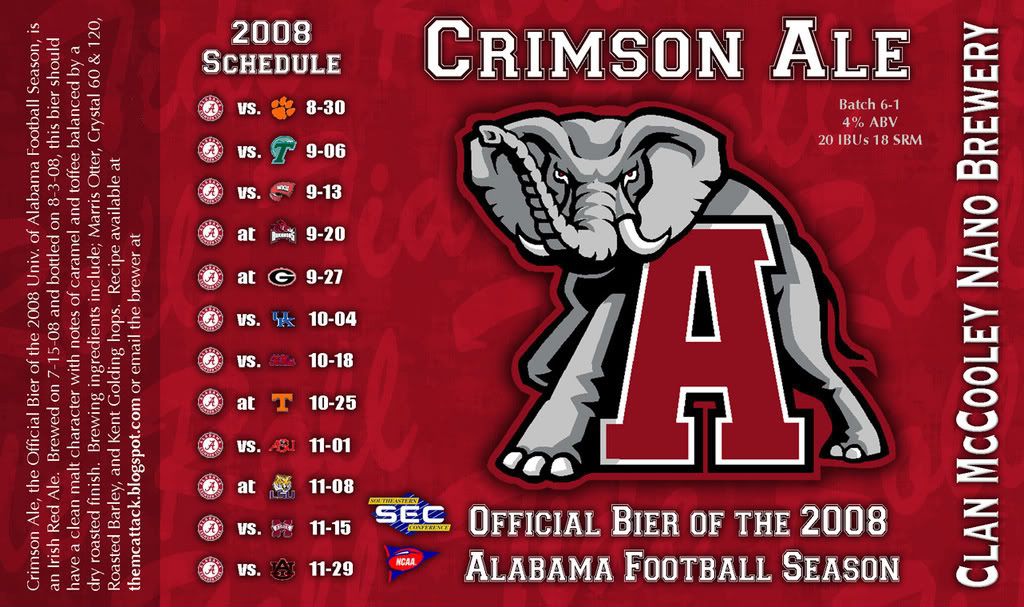
Crimson Ale, Official Ale of the 2008 Univ. of Alabama Football Season


     This is the label for an Irish Red Ale I brewed on July 16th. This bier is designed to be another low alcohol session brew. What makes this one special though is it's intended purpose. I intend to drink this bier throughout the upcoming 2008 college football season when watching Alabama games. I'm sure I'll have one while watching other games, but that could lead to a problem!  If it's as quaffable as it should be the real challenge will be making it last for three and a half months... or hey I could brew more... problem solved! I'm currently planning my next batches to be a partial mash Hobgobblin clone and another session brew, probably a mild, also for football season.
     This is the recipe for a 5 gallon batch:
7 # Marris Otter
.5 # Carapils
.375 # Caramel 60
.25 # Caramel 120
.25 # British Roasted Barley
1.08 oz. Kent Golding hops with 4.8 AAU
Mash 1.3 U.S. Qts of water per pound of grain @ 154 degrees f.
Sparge with close to 2 U.S. Qts of water per pound of grain @ 178 degrees f.
Safale S-04 yeast pitched onto approx. 2-3 cups of slurry from Breakfast Stout (see below)
Ferment at 60-65 degrees f.

SG 1.042 estimated FG 1.011 estimated abv 4%
IBUs 20 SRM 18

I almost forgot... Roll Tide!

(click on the label to enlarge)

Friday, July 11, 2008

Old Peculiar Ale Label

Old Peculiar Ale

Above is an Old Peculiar bier label I designed for my clone homebrew of the original Old Peculier bier.  The back ground is distressed metal.  The character is Gabby Hayes the old western movie actor.  Always enjoyed the peculiar characters he played.


Related Posts Plugin for WordPress, Blogger...